
Ness County Court Records After a Jail Arrest
After a person is arrested in Ness County and booked at the Ness County Jail, the jail side and the court side can move on different tracks. The jail is operated by the Ness County Sheriff's Office at 221 W Main St, Ness City, KS 67560. Sheriff Brandon Mitchell is the elected sheriff, with Undersheriff Jose Sandoval also listed by the county. The jail phone number is 785-798-3611, but the jail booking entry is not the same thing as a filed criminal case.
Formal Ness County court records after an arrest start when County Attorney Jacob Gayer files a complaint, information, or other charging document in district court. The County Attorney's office is listed at 202 W Sycamore, Ness City, on the top floor of the courthouse, with phone 785-798-3111 and email countyattorney@nesscountyks.gov. Once a case exists, the Ness County District Court file becomes the place to confirm filed counts, court dates, bond orders, warrants issued by the court, and final disposition.
The booking side remains useful for custody status, jail contact, and release information. For custody-focused records, use Ness County jail inmate records. For photo and booking-image questions, use Ness County jail mugshots. Court records after a jail arrest answer a different question: what charge did the prosecutor file, what is the status of each count, and what did the district court do with the case?
How to Find Ness County Court Records After an Arrest
Ness County is part of the Kansas 24th Judicial District. Local district court contact information is published on the Ness County District Court page, which lists phone 785-798-3693, fax 785-798-3348, mailing address PO Box 445, Ness City, KS 67560, and office hours of 8 a.m. to noon and 1 p.m. to 5 p.m. The same court page identifies Chief Judge Bruce T. Gatterman, Magistrate Judge R. Scott Barrows, and Clerk Lindsey A. Weigle. Kansas Judicial Branch materials also place the Ness County Courthouse in the 24th Judicial District.
For online case lookup, start with Kansas Case Search. The portal supports searches by case number, party name, business name, citation, or other role-based criteria. Direct form inspection was blocked during research, so field labels should be confirmed on the portal before relying on a single search method. A person booked into the Ness County Jail may not have an immediately visible court file if the prosecutor has not yet filed charges or if the case is sealed, restricted, or indexed differently.
- Open Kansas Case Search and choose the search method that matches the information available.
- Search by defendant name first if no case number is known, using spelling variants when appropriate.
- If a citation, complaint number, or case number is available from paperwork, search that number separately.
- Open the matching case and read the charge list, filing date, events, bond entries, and disposition for each count.
- If the case cannot be found online, contact the Ness County District Court clerk before assuming no court record exists.
| Case Search Field | Use It For | Ness County Note |
|---|---|---|
| Case number | Finding a known district court file directly. | Best when a court notice, bond paper, or clerk entry provides the number. |
| Party name | Searching by defendant name after an arrest. | Try legal name, common spelling variants, and middle initial when needed. |
| Business name | Finding cases tied to a business entity. | Less common for jail arrest matters, but available in the statewide portal. |
| Citation | Traffic or citation-based criminal filings. | Useful when the arrest followed a citation or traffic stop. |
| Role-based criteria | Filtering by a person's role in the case. | Confirm current options inside Kansas Case Search. |
Kansas Judicial Branch pages for district court records and requesting court records explain statewide access rules. Those statewide resources are useful when the local clerk refers a requester to eCourt procedures or when copies are needed instead of a simple index check.
The Kansas 24th Judicial District page confirms Ness County's district assignment. That matters because district-court criminal filings are court records, while the sheriff's booking record is a jail record. A court record following a Ness County arrest may also include hearings held by a district judge or magistrate judge, even though the arrest itself began with law enforcement.
The Kansas Case Search landing page is one subject-matched source for court record lookup:
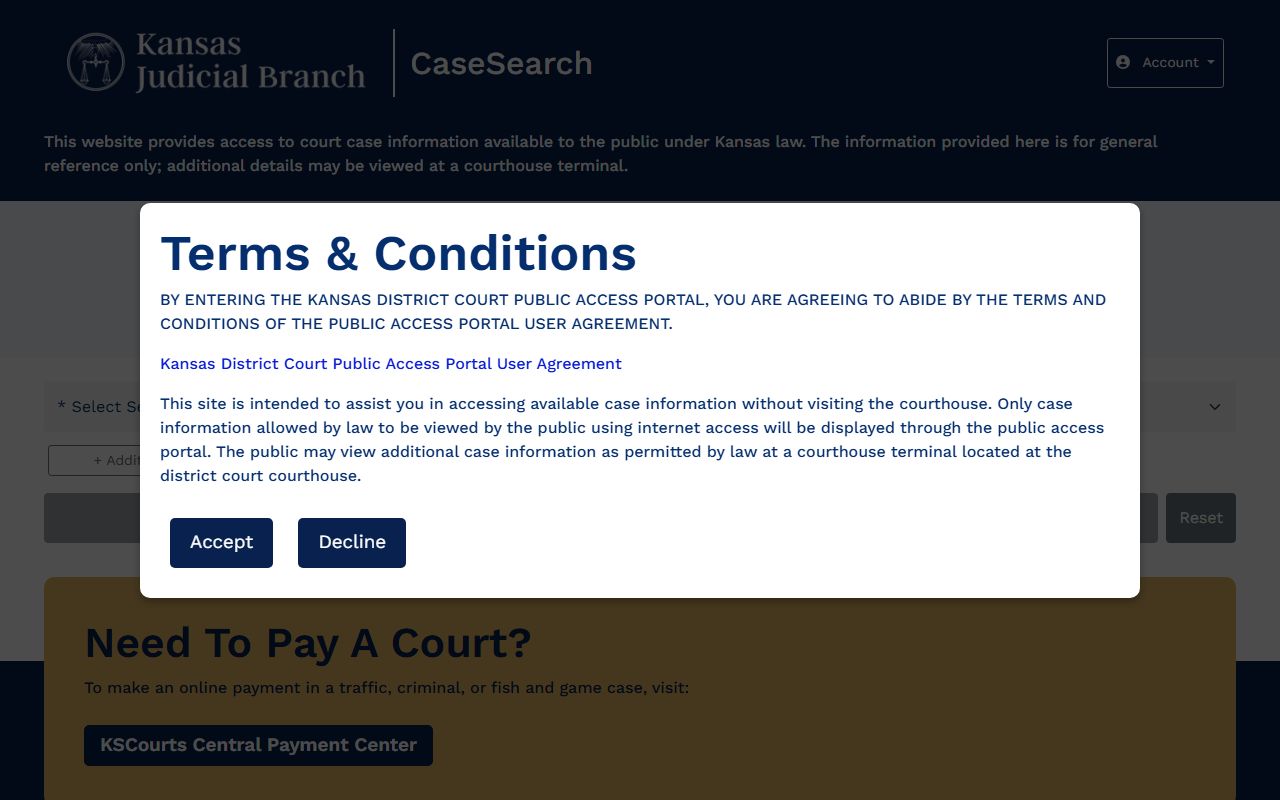
Use the statewide portal for filed court cases, then use the Ness County court clerk when a name search is inconclusive or a certified copy is needed.
How Charges Get Filed After an Arrest: Complaint, Information, and Indictment
A Ness County arrest can begin with a law-enforcement report, a warrant, or an on-view arrest. The court case begins only after a charging document is filed. The County Attorney reviews the facts and chooses what to file, if anything. That is why the jail booking description may not match the eventual court record. Booking language can be broad or preliminary, while the court file should identify the count, statute, severity level, and current status as the case moves forward.
| Complaint | Information | Indictment | |
|---|---|---|---|
| Filed By | Commonly filed by the prosecutor to start a criminal case. | Filed by the prosecutor as the formal statement of charges. | Returned by a grand jury when that process is used. |
| Common For | Misdemeanor or initial felony filings, depending on procedure. | Many felony prosecutions after review by the prosecutor. | Serious or grand-jury matters, less routine than prosecutor-filed charges. |
| Starts | The court case or the first filed accusation. | The formal criminal case or amended formal accusation. | The court case based on grand-jury accusation. |
| Why It Matters | Shows what the state alleges at filing. | Can replace or refine the first charge record. | Shows a grand-jury finding that charges should proceed. |
Charge Status in Court Records After a Ness County Arrest
Charge status is the reason court records after an arrest should be read count by count. One case can have several charges with different outcomes. A charge may be pending while another is dismissed. A prosecutor may amend a count to a different statute, reduce severity, add a new count, or dismiss a count under a plea agreement. A booking record from the Ness County Jail does not prove conviction and may not reflect later changes made in district court.
| Status | What It Means | How to Read It |
|---|---|---|
| Pending | The charge has been filed and is not yet resolved. | Check future court events, bond conditions, and whether the count has been amended. |
| Amended or Reduced | The filed charge changed after review, hearing, or agreement. | Compare the original count with the current count before summarizing the case. |
| Dismissed | The court no longer has that count pending against the defendant. | Look for whether dismissal applied to one count or the entire case. |
| Nolle Prosequi | The prosecutor declined to proceed with a charge. | Confirm whether other counts in the same case remain active. |
| Convicted | A plea or verdict resulted in a finding of guilt. | Read the sentencing entry and do not rely on the original arrest wording alone. |
Bond and Release After an Arrest
Bond decisions connect jail custody to the district court file. A person may be held at the Ness County Jail until first appearance, until bond is posted, or until a court changes the release conditions. The jail can confirm current custody status, but the court record is usually where the release order, bond conditions, and hearing entries appear. A hold from another agency, a detainer, or a warrant from another court can keep someone in custody even when a Ness County bond has been set.
| Bond Type | How It Works |
|---|---|
| Cash Bond | The court requires a cash amount before release, subject to the court's conditions. |
| Surety Bond | A licensed bonding company may post bond for the defendant under Kansas practice. |
| PR or Own Recognizance | The court releases the person on a promise to appear, with conditions if ordered. |
| No-Bond Hold | The person remains in custody because the court or another authority has not authorized release. |
| Detainer or Outside Hold | Another agency, court, probation authority, parole authority, or jurisdiction is asking the jail to hold the person. |
Warrants That Lead to an Arrest
No Ness County active warrant list was located in the research. The practical warrant path is to contact the Ness County Sheriff's Office at 785-798-3611, check Kansas Case Search for court entries, and contact the issuing court when a warrant appears to come from outside Ness County. The sheriff's website also provides public contact options, including a message form and a submit-a-tip form, but those forms are not a warrant search or confirmation service.
An arrest warrant is usually issued before arrest when a court finds probable cause or a charging process supports it. A bench warrant is usually issued by a judge after a missed court date or violation of a court order. A detainer asks the jail to hold a person for another agency or jurisdiction. A probation or parole warrant can hold a person because a supervision authority alleges a violation. Each type can result in jail booking, but each has a different source and should be verified with the court or agency that issued it.
Charges vs. Convictions
Being arrested or charged in Ness County is not the same as being convicted. Court records after a jail arrest may show accusations, hearings, dismissed counts, plea entries, trial results, and sentencing. The final disposition controls the difference between an allegation and a conviction. When a record is being reviewed for legal, employment, licensing, housing, or immigration reasons, the disposition and any later expungement order matter more than the booking phrase.
| Charge | Conviction | |
|---|---|---|
| Stage | An accusation filed by the state after review. | A final result based on a guilty plea, no-contest plea, or verdict. |
| Proof Level | Supported by probable cause or charging standards. | Resolved under the criminal proof standard and court procedures. |
| Public Record | Often public unless sealed, restricted, or exempt. | Often public unless expunged, sealed, or otherwise restricted. |
| Why It Matters | Does not prove guilt. | Can carry sentence, supervision, fines, and collateral consequences. |
Sealed vs. Expunged Arrest Records
Kansas records law starts from public access but also recognizes limits. K.S.A. 45-216 states the policy that public records are open unless otherwise provided by law. K.S.A. 45-218 covers agency response, refusal, fees, and the general requirement that action on a request occur not later than the third business day. K.S.A. 45-220 addresses request procedures. K.S.A. 45-221 lists exemptions, including criminal-investigation and security-related records that may affect jail or law-enforcement files.
For record clearing, Kansas has separate expungement provisions. K.S.A. 22-2410 addresses arrest-record expungement. K.S.A. 21-6614 addresses expungement for convictions, arrests, and diversions under listed conditions. Eligibility depends on the charge, outcome, waiting period, later criminal history, and court findings. A dismissal does not automatically erase every public trace of an arrest, and an expungement order does not mean every agency record was never created.
| Sealed | Expunged | |
|---|---|---|
| Visibility | Removed from ordinary public view or access. | Restricted by court order under Kansas expungement law. |
| Law Enforcement | May remain available for limited official purposes. | May remain available for purposes allowed by Kansas law. |
| Eligibility | Depends on the record type and legal authority for sealing. | Depends on K.S.A. 22-2410, K.S.A. 21-6614, and the case outcome. |
| Practical Step | Ask the district court clerk what access rule applies. | Review the statute and court process before relying on removal from public indexes. |
Background Check Considerations
Casual court lookup is not the same as a regulated background check. Kansas Case Search, district court records, sheriff booking records, and jail custody records may help identify a case, but they can be incomplete, delayed, restricted, or updated after first publication. A person using Ness County court records after an arrest should compare the booking record, filed charges, court events, and final disposition before drawing conclusions.
Important: Ness County Inmate Population is not a consumer reporting agency and cannot be used for FCRA-covered decisions.
Restricted Court Records After an Arrest in Ness County
Some court or law-enforcement records may be unavailable to the public. Juvenile matters, sealed cases, expunged records, victim information, security details, and active criminal-investigation records can be restricted. KORA's open-records policy does not require release of every criminal record in every circumstance, and K.S.A. 45-221 gives agencies grounds to withhold or redact certain records. If an online search does not show a case, the possible reasons include no filed case, spelling or indexing differences, filing delay, sealed status, expungement, or a record held by a different court.
Ness County's mobile application announcement and app URL at app.nesscountyks.gov were documented in the research, but no roster, warrant, mugshot, or court-case feature was documented for the app. For court records after an arrest, the better access chain is still Kansas Case Search, the Ness County District Court clerk, and the County Attorney or sheriff only when the question belongs to prosecution or jail custody.